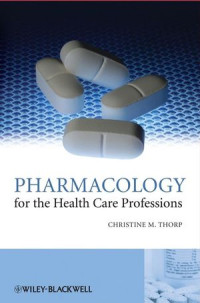
Text
Pharmacology for theHealth Care Professions
Preface
The need for a book such as this one has arisen as a result of recent changes in legislation
and expansion in the numbers of health care professionals involved in administration
and/or prescription of medicines.
The book is an introduction to pharmacology for health care professionals. Although
anyone involved in the care of patients is a health care professional, this book has been
specifically written for physiotherapists, podiatrists and radiographers (otherwise known
as allied health professionals). However, the book may be of interest to other health care
professionals.
The book aims to provide the knowledge of pharmacology necessary for under-
graduates of all three professions and practitioners on post graduate programmes for
accreditation of supplementary prescribing or access and supply of prescription-only
medicines. It may also be of more general use to any health care professional involved
in patient care, especially those who administer medicines under patient group directions.
The book is arranged into three parts. In the first part, Principles of Pharmacology,
two chapters cover administration, absorption, distribution, metabolism and excretion of
drugs (Chapter 2) and adverse drug reactions, drug–drug interactions, individual response
to drugs and targets for drug action (Chapter 3).
The second part is Systemic Pharmacology, which covers common disorders of the
major body systems and their treatment. The cardiovascular, respiratory, endocrine, mus-
culoskeletal, skin and central nervous systems are considered. An outline of normal
physiology of the systems is included where appropriate and relevant diseases described
briefly. This is not intended to be a physiology book or a pathophysiology book. Should
the reader need to consult such books, suggestions are given in the bibliography. Major
groups of drugs are discussed, with emphasis on areas of relevance to the three professions
for whom the book is intended.
In addition to drugs used to treat diseases of the major systems, the treatment of
infections and parasites, the use of cancer chemotherapy, the use of anaesthetics and
analgesics and the use of contrast agents and adjuncts to radiotherapy are included in
Part 2.
The final part has two chapters. The first of the two (Chapter 14) is about legislation
around the use of medicines with discussion of salient points from the Medicines Act
1968 and the Misuse of Drugs Act 1971. Specific exemptions for podiatrists, the use of
patient group directions, supplementary prescribing and independent prescribing and a
brief history of non-medical prescribing are considered.
The final chapter (Chapter 15) ‘Prescribing in Practice’ consists of contributions from
podiatry, radiography and physiotherapy colleagues. They have described the use of
xvi PREFACE
various forms of access, supply, administration and prescription of medicines in their
professions today and considered future developments in the light of the recent legislation
allowing pharmacists and nurses to train as independent prescribers. Hopefully this will
give the reader a realistic view of what is currently happening and what might happen
in non-medical prescribing.
Useful web sites are listed at the end of each chapter, to encourage the reader to use
the Internet for sources of reliable and respectable up-to-date information about disease,
medicines and therapeutics. Although all websites were accessible at the time of writing,
their existence cannot be guaranteed in the future.
Each chapter is followed by one or more case studies to illustrate the clinical use of
drugs and problems that may arise from drug–drug interactions and adverse reactions.
The situations are not based on any particular individuals; rather information has been
gathered from many sources including my colleagues in physiotherapy and podiatry and
used to construct the cases.
Finally, the chapters are finished off with review questions to test the reader’s under-
standing of key concepts.
In the appendices, a list of drug names with their main therapeutic uses and a glossary
of key terms used in the text are provided.
Drugs in current use are not all covered in this text; neither is this work intended as a
recommendation for any drug use. Professionals should always consult the latest edition
of the British National Formulary for definitive information about medicines.
Ketersediaan
Tidak ada salinan data
Informasi Detail
- Judul Seri
-
-
- No. Panggil
-
-
- Penerbit
- University of salfo : WILEY-BLACKWELL., 2008
- Deskripsi Fisik
-
-
- Bahasa
-
English
- ISBN/ISSN
-
-
- Klasifikasi
-
NONE
- Tipe Isi
-
-
- Tipe Media
-
-
- Tipe Pembawa
-
-
- Edisi
-
-
- Subjek
-
-
- Info Detail Spesifik
-
-
- Pernyataan Tanggungjawab
-
-
Versi lain/terkait
Tidak tersedia versi lain
Lampiran Berkas
Komentar
Anda harus masuk sebelum memberikan komentar
 Karya Umum
  Filsafat
  Agama
Agama  Ilmu-ilmu Sosial
  Bahasa
  Ilmu-ilmu Murni
  Ilmu-ilmu Terapan
  Kesenian, Hiburan, dan Olahraga
  Kesusastraan
  Geografi dan Sejarah
  Jurnal
  Proceeding